Winter entryways have a tough job.
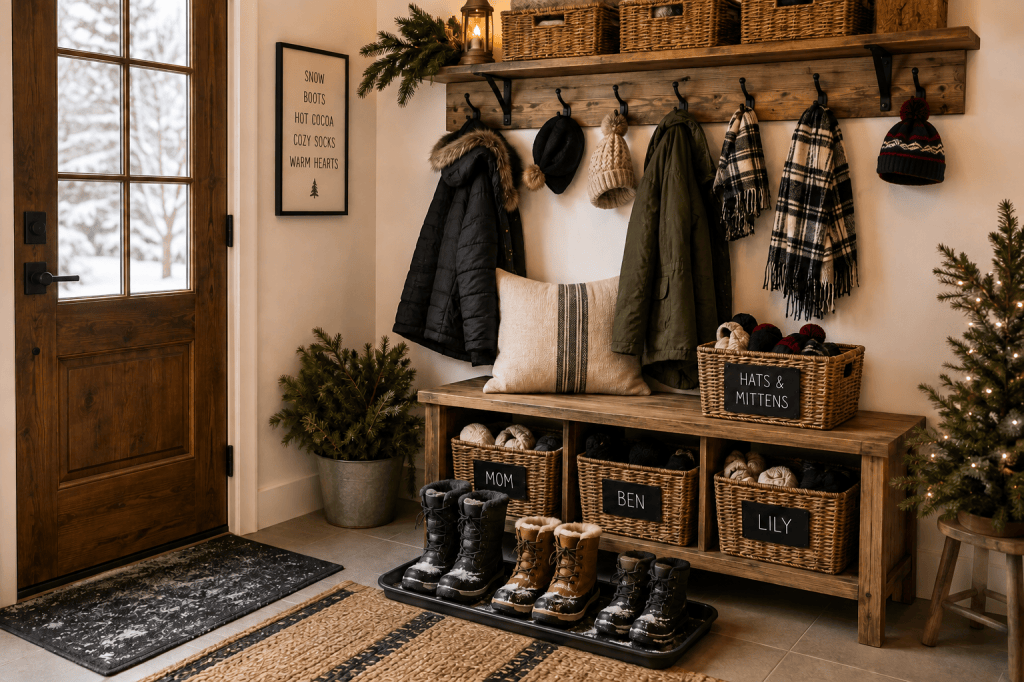
They’re expected to handle snowy boots, wet mittens, bulky coats, hats, backpacks and everything else that comes through the door—while somehow remaining a pleasant place to walk into.
The good news is that you don’t need a giant mudroom or custom built-ins. A few simple systems can make even a small entryway work much better through a long northern winter.
Affiliate Disclosure: This post contains affiliate links. As an Amazon Associate, Northern Home & Garden earns from qualifying purchases at no additional cost to you.
The Quick List
If winter gear is taking over your entryway, start with these seven things:
- Give everyone a basket or bin
- Create a dedicated boot zone
- Hang wet gear instead of piling it
- Keep everyday mittens and hats easy to grab
- Use your wall space
- Create a drying station
- Keep everyday gear within reach
That’s really the whole system.
Now let’s make it work.
1. Give Everyone Their Own Basket
Winter accessories multiply.
Mittens, hats, neck warmers, scarves, hand warmers and all the other little things somehow end up everywhere except where you need them.
One of the easiest solutions is to give each person a designated basket or bin. Wall-mounted wire baskets are another good option, especially when floor or shelf space is limited. A set of extra-large hanging wire baskets can keep hats, mittens and other winter gear visible and easy to grab.
It doesn’t have to be fancy.
A labeled basket on a shelf can hold the smaller items that would otherwise disappear into drawers, closets and coat pockets.
For families, this also eliminates the morning question:
“WHERE ARE MY GLOVES?!”
Or at least reduces it.
Let’s not promise miracles. 😂
❄️ Northern Tip
If children use the entryway, put their everyday baskets somewhere they can actually reach.
A beautiful organizing system isn’t very useful if the people using it can’t put their own things away.
2. Create a Dedicated Boot Zone
Wet winter boots need somewhere to go immediately after coming through the door.
Without a designated spot, melting snow ends up across the floor—and eventually farther into the house.
A waterproof boot tray is one of the simplest solutions. For a larger household, an extra-large boot tray like the SUPENUIN 48-inch Boot Tray gives you room for several pairs at once.
Put it as close to the entrance as practical so snowy boots come off before anyone walks through the house.
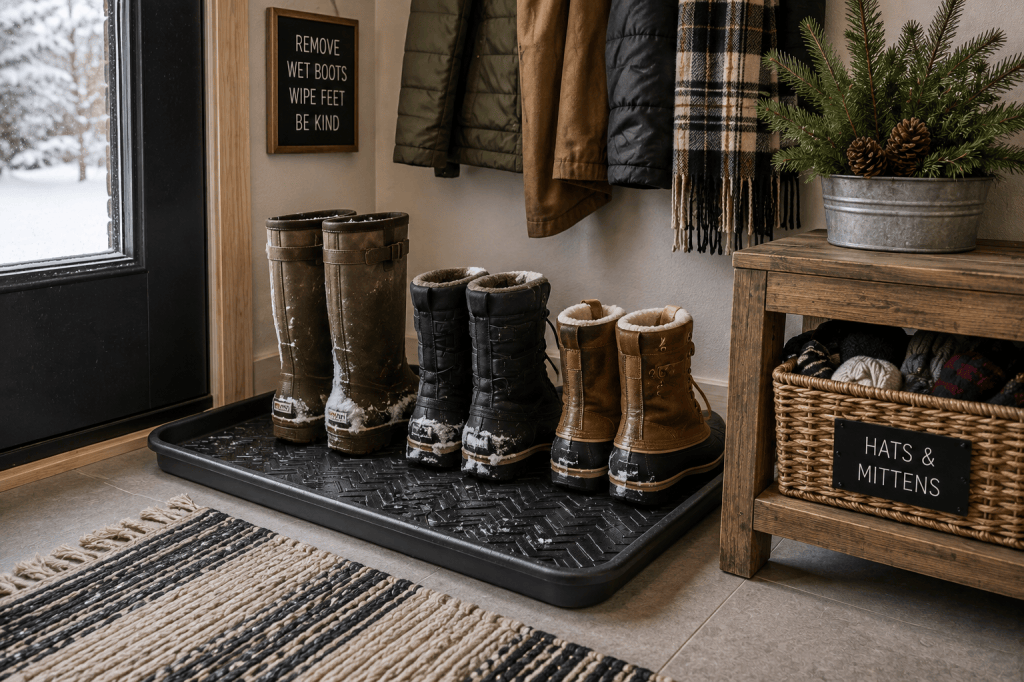
If several people are coming and going every day, make sure the boot area is large enough for the number of pairs you realistically use.
A tiny tray holding two perfectly arranged boots may look lovely in a photograph.
It isn’t terribly useful for a family with eight wet boots. 😂
❄️ Northern Tip
Think about meltwater, not just storage.
Your winter boot area needs to contain water and be easy to clean. Hard, moisture-resistant surfaces are especially practical near snowy entrances.
3. Hang Wet Gear—Don’t Pile It
A pile of wet snow pants, coats and mittens isn’t going to dry particularly well.
Give damp gear room for air to circulate around it.
Hooks are often more practical than hangers for everyday winter clothing because they’re quick and easy to use.
Install enough hooks that coats aren’t stacked three deep on top of each other.
And if children use the space, consider adding a lower row of hooks.
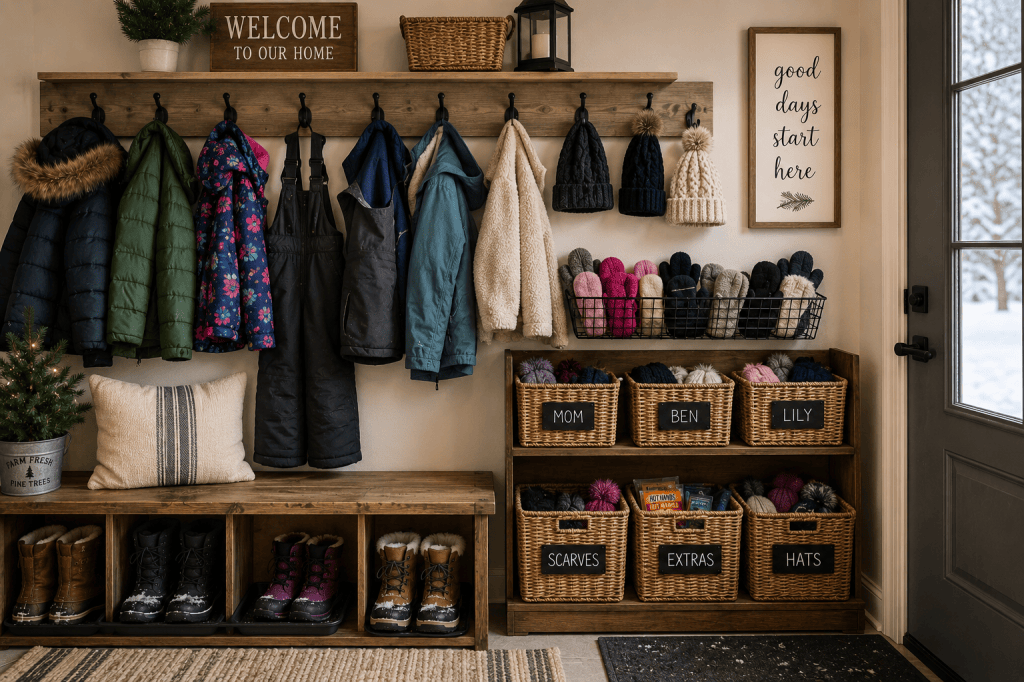
They can hang up their own coats and snow pants instead of leaving them on the floor.
At least that’s the theory. 😂
❄️ Northern Tip
Don’t cram soaking-wet gear immediately into closed cabinets or tightly packed baskets.
Let it dry first.
4. Create a Grab-and-Go Mitten Station
There are two kinds of winter gear:
The things you use every day
and
the things you might need sometime this winter.
They don’t need to live in the same place.
Keep everyday mittens, hats and neck warmers close to the door in an open basket, drawer or easy-to-reach bin.
Backup gloves, ski gear and less frequently used accessories can live somewhere else.
This keeps your entryway from becoming storage for every winter item your family owns.
❄️ Northern Tip
Keep a small container nearby for single mittens.
Eventually their partners may return from whatever mysterious dimension consumes children’s gloves.
5. Use Your Vertical Space
Small entryway?
Look up.
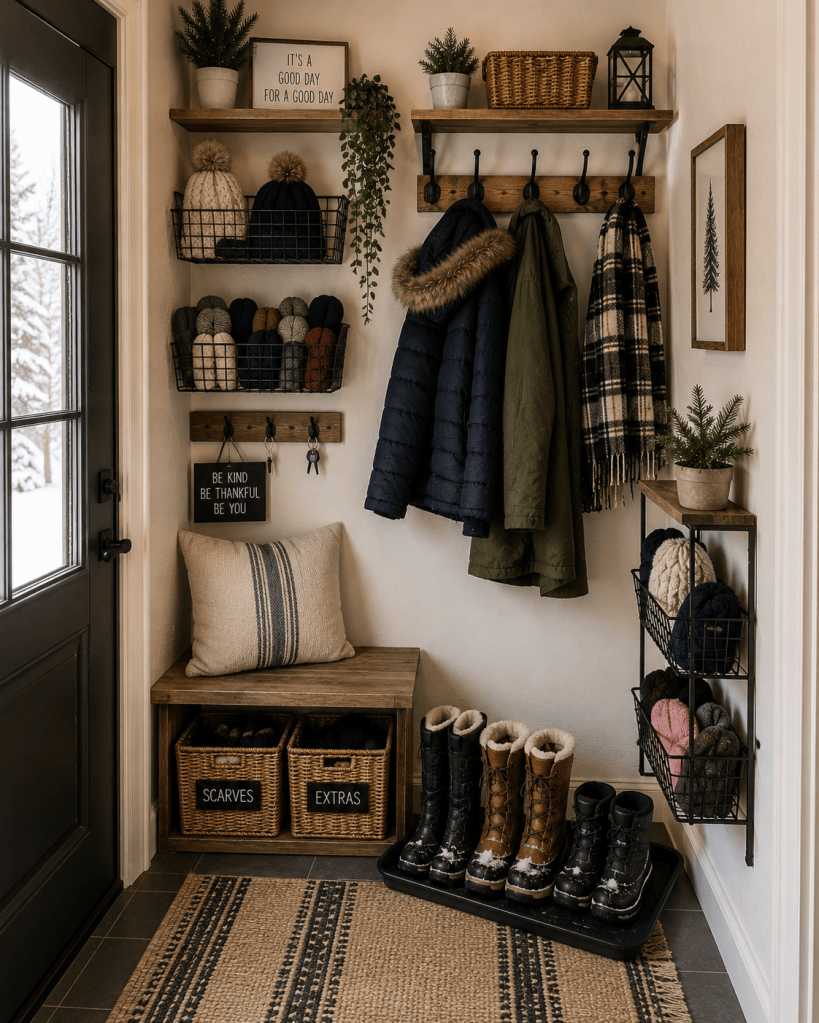
Walls and doors can provide an enormous amount of useful storage without taking up additional floor space.
Depending on your space, consider:
- Wall hooks
- Peg rails
- Narrow shelving
- Over-the-door organizers
- Wall-mounted baskets
- Tall cubbies
Save the floor for the things that really need it—primarily boots and perhaps a bench.
Small Entryway Idea
An over-the-door organizer isn’t only for shoes.
The pockets can hold:
- Mittens
- Hats
- Hand warmers
- Sunglasses
- Small flashlights
- Dog supplies
- Other little grab-and-go items
It’s inexpensive storage that uses almost no additional room.
6. Create a Drying Station
This might be the most important difference between organizing an ordinary entryway and organizing one for a real northern winter.
Winter gear doesn’t simply need storage.
It needs to dry.
Designate one part of your entryway or mudroom for wet items.
That might include:
- Hooks with plenty of space between garments
- A drying rack
- A washable or waterproof floor surface
- A boot tray
- Good airflow
- A place for wet mittens
- And yes…
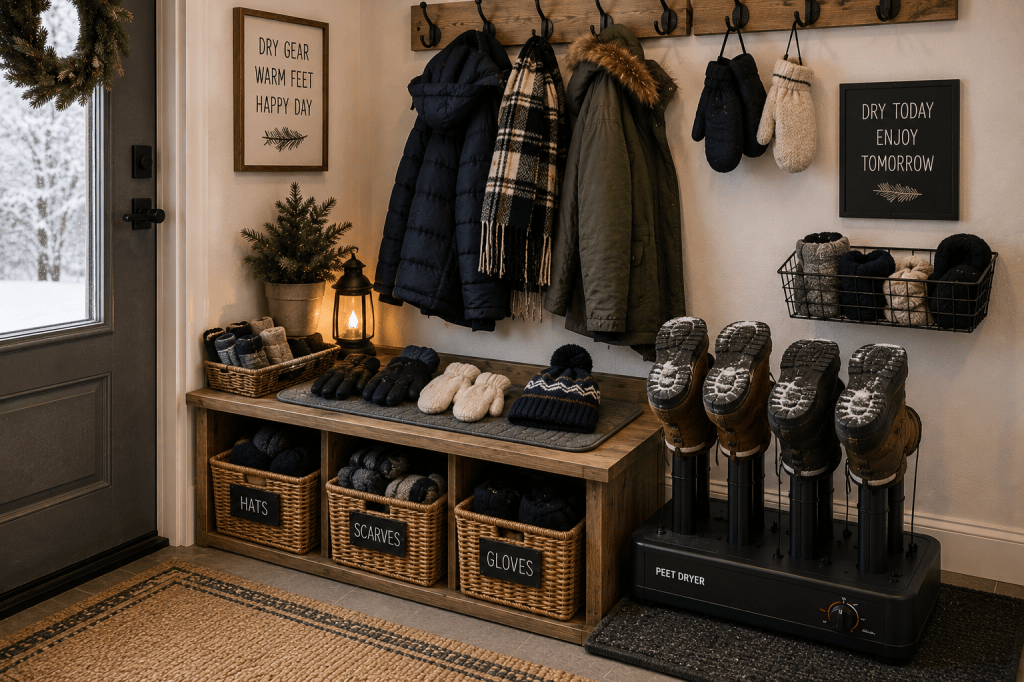
A Boot Dryer
If your household regularly deals with snow, slush and wet boots, a boot dryer can be incredibly useful. A simple electric boot dryer like the PEET Original Dryer can give wet boots a designated place to dry between uses.
Dry boots are more comfortable the next time you put them on, and having a designated drying routine helps keep damp footwear from sitting around the entryway indefinitely.
Some dryers can also accommodate gloves or mittens, depending on the design.
❄️ Northern Tip
If several family members regularly have wet boots, think about capacity before buying a dryer.
A two-boot dryer may be perfect for one person but quickly become a traffic jam in a larger household.
7. Keep Everyday Gear Within Reach
The easiest organizing system to maintain is the one that matches what your family actually does.
Put the things you use every day closest to the door.
Prime entryway space:
- Everyday coats
- Current boots
- Mittens
- Hats
- Backpacks
- Keys
Secondary storage:
- Ski gear
- Spare coats
- Extra boots
- Off-season items
- Backup gloves
- Specialty outdoor gear
Don’t make yourself dig through five bins every morning for something you use six days a week.
Organize according to frequency, not just category.
What If You Don’t Have a Mudroom?
You don’t need one.
A small entryway, hallway or even a section of wall near the door can function as a mini winter drop zone.
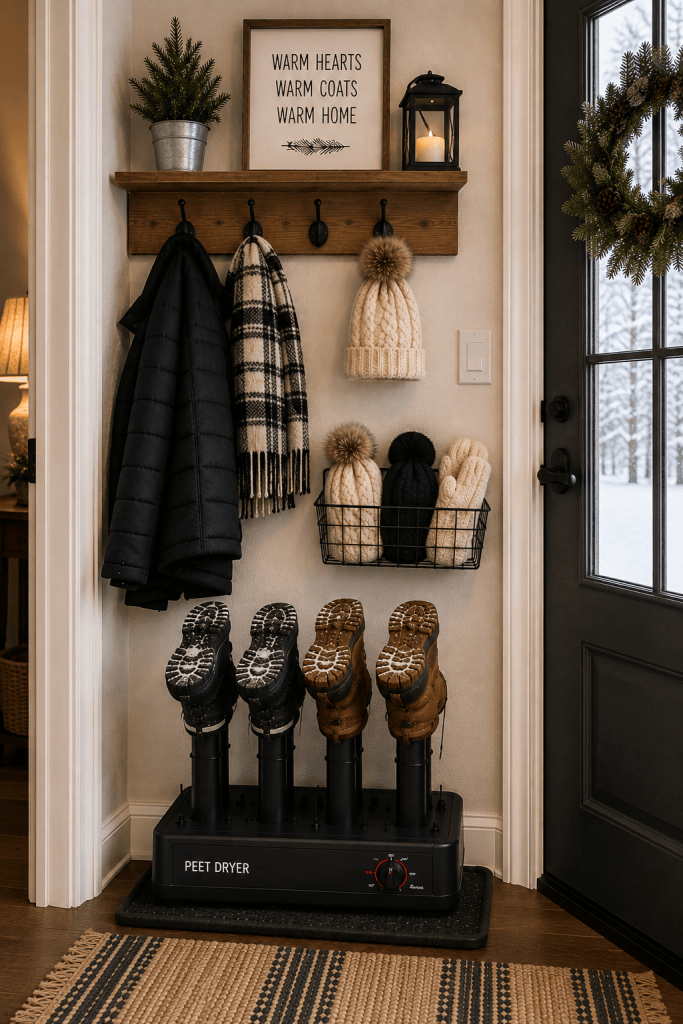
Start with the basics:
- One boot tray
- A few sturdy hooks
- One basket per person
- A small bench if you have room
That’s enough to create a functional system.
If space is extremely limited, vertical storage becomes even more valuable.
The goal isn’t to recreate a giant Pinterest mudroom.
It’s to keep snowy gear from taking over the rest of your house.
What About a Bench?
If you have the room, a bench is one of the most useful additions to a winter entryway.
It’s somewhere to sit while wrestling with winter boots—which is reason enough. 😂
But it can also provide storage underneath or inside.
Open cubbies underneath work well for frequently used footwear.
Closed storage can hide less attractive items, but remember not to seal soaking-wet gear inside without allowing it to dry.
❄️ Northern Tip
If you’re choosing between a beautiful bench with almost no useful storage and a simple bench that can handle boots, backpacks and daily abuse…
Northern winters vote for the useful one.
Don’t Forget the Floor
Winter entryways deal with:
- Melting snow
- Slush
- Road salt
- Gravel
- Mud
- Ice
- Wet boots
This is not the place for a precious rug you are afraid to walk on.
Use flooring and mats that can tolerate moisture and frequent cleaning.
A good system might include an exterior mat to remove snow and debris, followed by a durable interior mat and a waterproof boot tray.
The goal is to stop as much winter mess as possible right at the door.
Give Wet Gear Room to Dry
Organization isn’t only about making things look tidy.
Wet clothing and footwear introduce moisture into the home. If damp gear stays piled together or enclosed without enough airflow, it takes longer to dry and can contribute to unwanted moisture and odors.
Spread wet items out.
Use ventilation when necessary.
And pay attention if you’re seeing persistent condensation or other signs of excess indoor moisture.
❄️ Northern Tip
If the windows near your entryway are constantly covered in condensation during winter, don’t automatically assume that’s just part of living somewhere cold.
It can be a sign that indoor humidity is too high.
Make the System Easy Enough to Actually Use
This might be the most important rule of all.
If putting away a pair of mittens requires opening a cabinet, moving a basket, unlatching a decorative box and carefully folding them…
Nobody is going to do it.
Especially children.
Use:
- ❄️ Hooks instead of complicated hangers.
- ❄️ Open baskets instead of perfectly arranged drawers.
- ❄️ Boot trays instead of expecting wet footwear to magically remain clean.
Your entryway should be designed for the tired person coming home carrying groceries while someone is asking what’s for dinner.
Not for a photograph.
Cozy and Practical Can Coexist
A functional winter entryway doesn’t have to look industrial.
Once the practical pieces are working, add the things that make it feel like home:
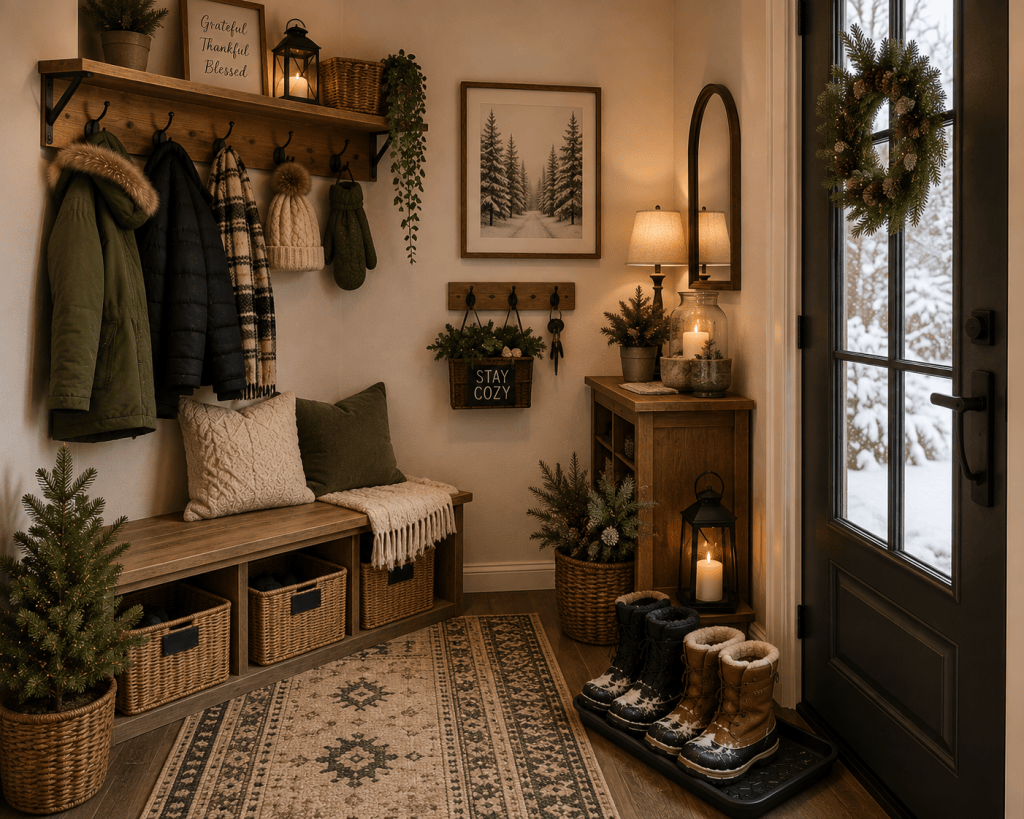
- A warm lamp
- Natural wood
- Woven baskets
- Evergreen branches
- A washable runner
- A simple wreath
- A comfortable bench cushion
- A few beautiful hooks
Start with function.
Then make it beautiful.
That’s a much easier order than designing a gorgeous entryway and discovering there isn’t anywhere to put a wet pair of snow pants.
A Winter Entryway That Actually Works
The goal isn’t a perfectly organized mudroom.
It’s a space where everyone knows:
Boots go here.
Wet things dry here.
Mittens live here.
Coats hang here.
When everything has a simple place—and that place matches the way your household actually moves through the door—winter becomes a little less messy.
The snow will still come inside.
But hopefully considerably less of it will make it past the entryway.

